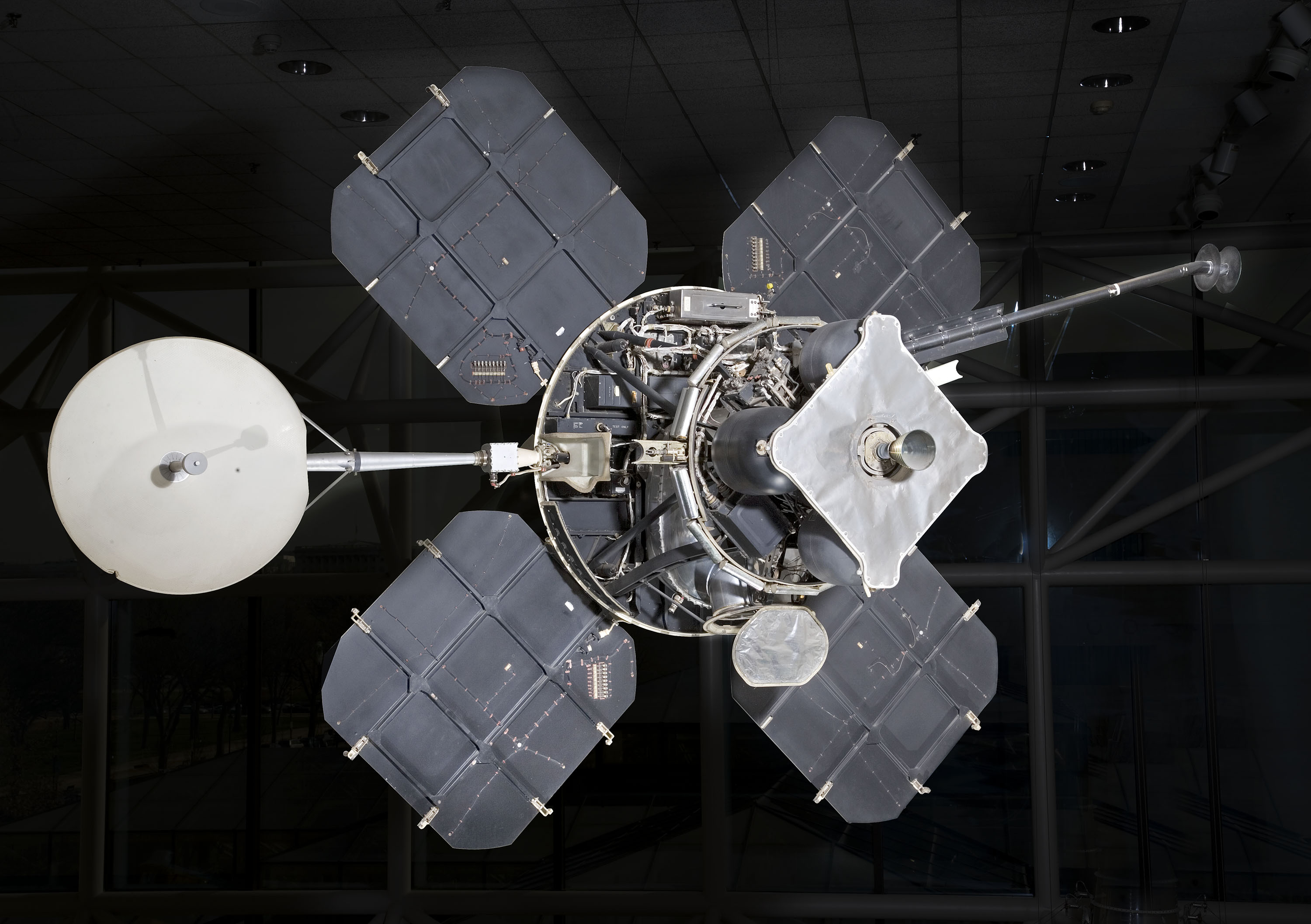
Satellite, Explorer 6, Reconstructed Replica
Object Details
- Manufacturer
- TRW Space & Technology Group
- Summary
- This is a full-scale replica of the Explorer 6 satellite. The spacecraft was designed to study the electrical and magnetic fields about the Earth and to test devices for scanning cloud cover. It was launched on August 7, 1959. Over its 60 days of operation it provided the most comprehensive data up to then of the Van Allen radiation belts and the geomagnetic field, as well as the first televised cloud cover pictures. This replica was assembled by the program coordinator, Space Technology Laboratories Inc., from original parts that failed to meet flight specifications. The solar panels are plastic mock-ups. The artifact was displayed at the California Museum of Science and Industry until February 1964, at which time it was donated by STL to the Smithsonian Institution.
- Alternate Name
- Explorer 6 Satellite (Reconstructed Replica)
- Country of Origin
- United States of America
- See more items in
- National Air and Space Museum Collection
- Location
- Steven F. Udvar-Hazy Center in Chantilly, VA
- Exhibit Station
- Space Science
- Credit Line
- Gift of TRW Space Technology Laboratories
- Data Source
- National Air and Space Museum
- Inventory Number
- A19640667000
- Type
- SPACECRAFT-Uncrewed
- Restrictions & Rights
- Usage conditions apply
- Materials
- Aluminum alloy, plastic
- Dimensions
- Overall: 2 ft. 5 in. tall x 2 ft. 2 in. wide, 50 lb. (73.7 x 66cm, 22.7kg)
- Record ID
- nasm_A19640667000
Irregular symmetrical black spheroid with one white panel, a cylindrical metal interstage attachment ring, two white antennae and four solar cell paddles on arms attached to waist of spacecraft.