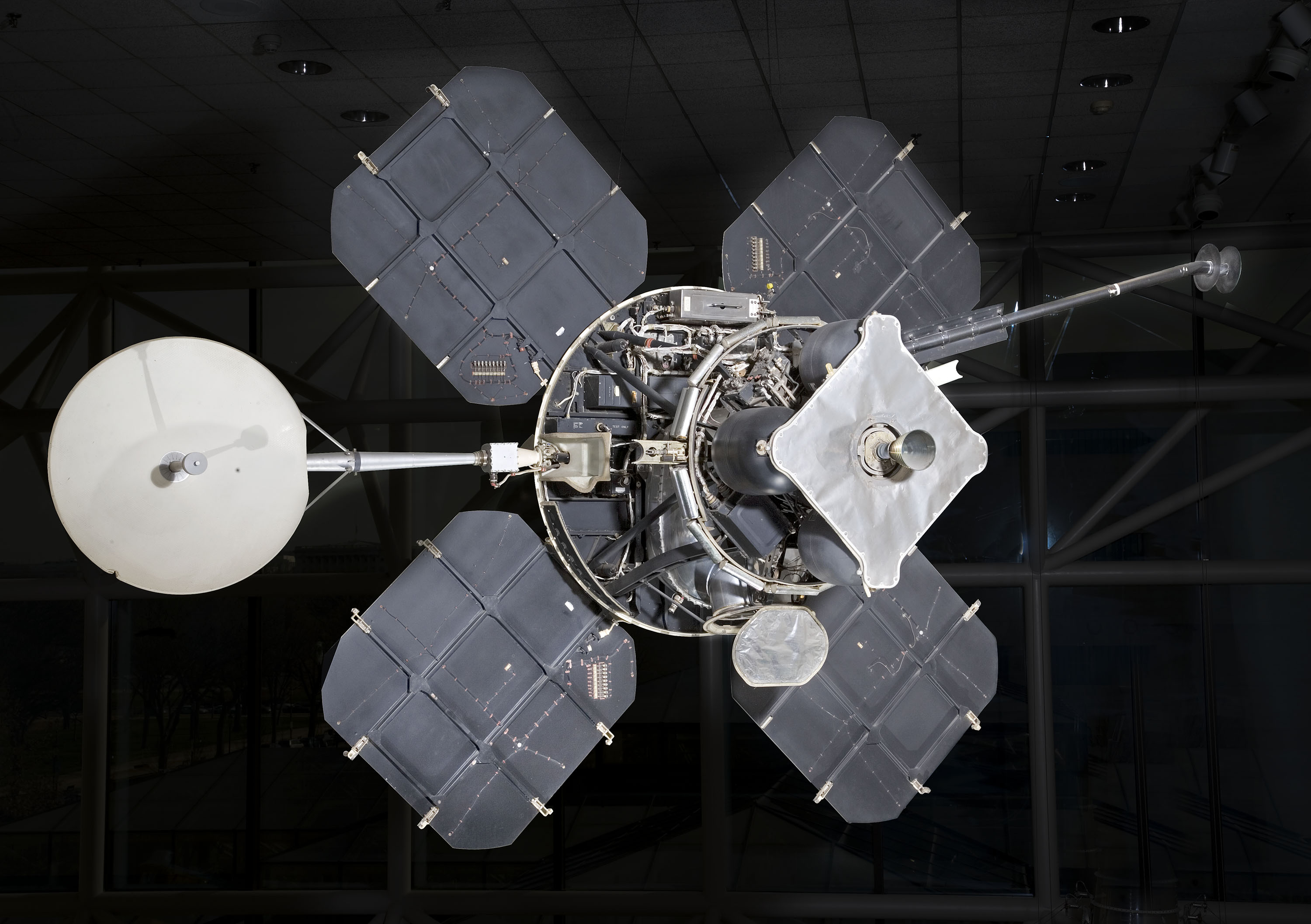
Leg Pad, Lunar Lander, Surveyor, Mockup
Object Details
- Manufacturer
- Hughes Aircraft Co.
- Summary
- This is a mock up one of the three landing legs for the Surveyor spacecraft mockup . Five Surveyor spacecraft successfully landed on the Moon during the period from May 30, 1966 to January 9, 1968. The overall objectives of the Surveyor program were to accomplish soft landings on the Moon, obtain data concerning temperature, chemical composition, and load-bearing characterisitics of the lunar soil in support of the Apollo program, televise high quality photographs of the lunar surface, and perform operations on the lunar surface that would contribute new scientific knowledge about the Moon.
- Long Description
- NASA originally conceived the Surveyor program in 1963 as a lander/orbiter combination project, but later scaled it down to only soft-landing. Each lander comprised a three-legged triangular aluminum structure with a large solid propellant retro-rocket engine at the base. The lander was equipped with an advanced imaging system. After three tests of the Atlas Centaur booster in 1965-1966, NASA launched Surveyor 1 in May 1966. The mission was a resounding success. The spacecraft landed successfully in the Ocean of Storms on June 2, 1966 and took more than 11,000 photos of the surface over a month-long period. Although Surveyor 2 failed, Surveyor 3 successfully landed on the Moon in April 1967. In addition to an imaging system, the lander also included a remote scooper arm to determine the density of lunar soil. Experiments showed that the lunar soil had the consistency of wet sand. More than two years later, in November 1969, Apollo 12 astronauts Charles Conrad, Jr. and Alan Bean landed their Intrepid Lunar Module about 180 meters from Surveyor 3 and recovered some its parts to evaluate the environmental effects of a long period on the Moon's surface. Surveyor 4 was a failure, but Surveyors 5, 6, and 7 successfully landed on the Moon in 1967 and 1968, returning vast amounts of photographs and data on the Moon that were critical to designing experiments for the Apollo missions. In total, the five successful Surveyors returned more than 87,000 photos of the Moon and showed that it was feasible to soft-land a large probe on the Earth's only natural satellite.
- Country of Origin
- United States of America
- See more items in
- National Air and Space Museum Collection
- Credit Line
- Gift of Hughes Aircraft Company
- Data Source
- National Air and Space Museum
- Inventory Number
- A19700129000
- Type
- SPACECRAFT-Uncrewed-Parts & Structural Components
- Restrictions & Rights
- Usage conditions apply
- Materials
- Aluminum, Paint, Steel, Adhesive
- Dimensions
- Storage (Rehoused on an aluminum pallet): 152.4 × 152.4 × 96.5cm, 136.1kg (60 × 60 × 38 in., 300lb.)
- Record ID
- nasm_A19700129000
77 x 5 x 12in.; white triangular truss frame with aluminum honeycomb foo