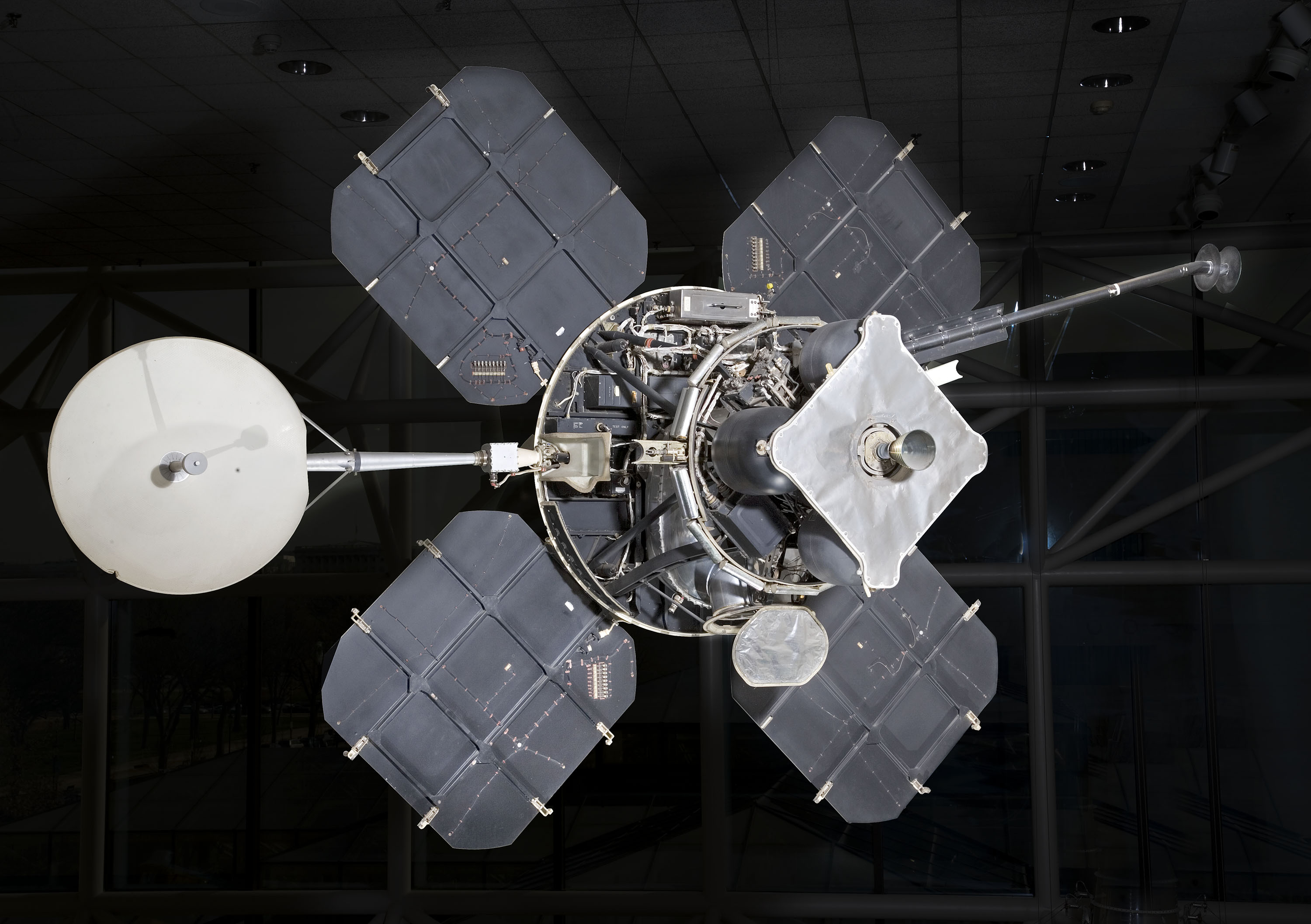
Structure, Lunar Orbiter
Object Details
- Manufacturer
- Boeing Company
- Summary
- The Lunar Orbiter spacecraft mapped the Moon in preparation for Apollo landings in the 1960s, completing five missions. Built by Boeing under contract to NASA’s Langley Research Center, the Lunar Orbiter’s highly complex imaging system delivered near global photographic coverage of the Moon, aiding in the determination of Apollo landing sites. Lunar Orbiter also provided scientific data that allowed the charting of radiation levels and gravity perturbations at the Moon. Among other things, Lunar Orbiter aided in knowledge development for Apollo’s highly accurate landings and precision rendezvous.
- This Lunar Orbiter structure in the Smithsonian Institution’s collection was a backup vehicle constructed in the event of additional flights for the program. Although built as flight hardware, it served principally as a reference article for scientists and engineers on Earth during the flights of other vehicles to the Moon in the 1965-1968 period.
- Country of Origin
- United States of America
- See more items in
- National Air and Space Museum Collection
- Credit Line
- Transferred from the Boeing Company through NASA - Langley Research Center
- Data Source
- National Air and Space Museum
- Inventory Number
- A19700192000
- Type
- SPACECRAFT-Uncrewed-Test Vehicles
- Restrictions & Rights
- Usage conditions apply
- Materials
- Adhesive, Aluminum, Steel, Synthetic Fabric, Velcro, Wood, Paint, Mylar (Polyester)
- Dimensions
- 3-D: 177.8 x 457.2cm (70 in. x 15 ft.)
- Record ID
- nasm_A19700192000
70 x 60in. diameter; upper structure with thermal shield; without camera.