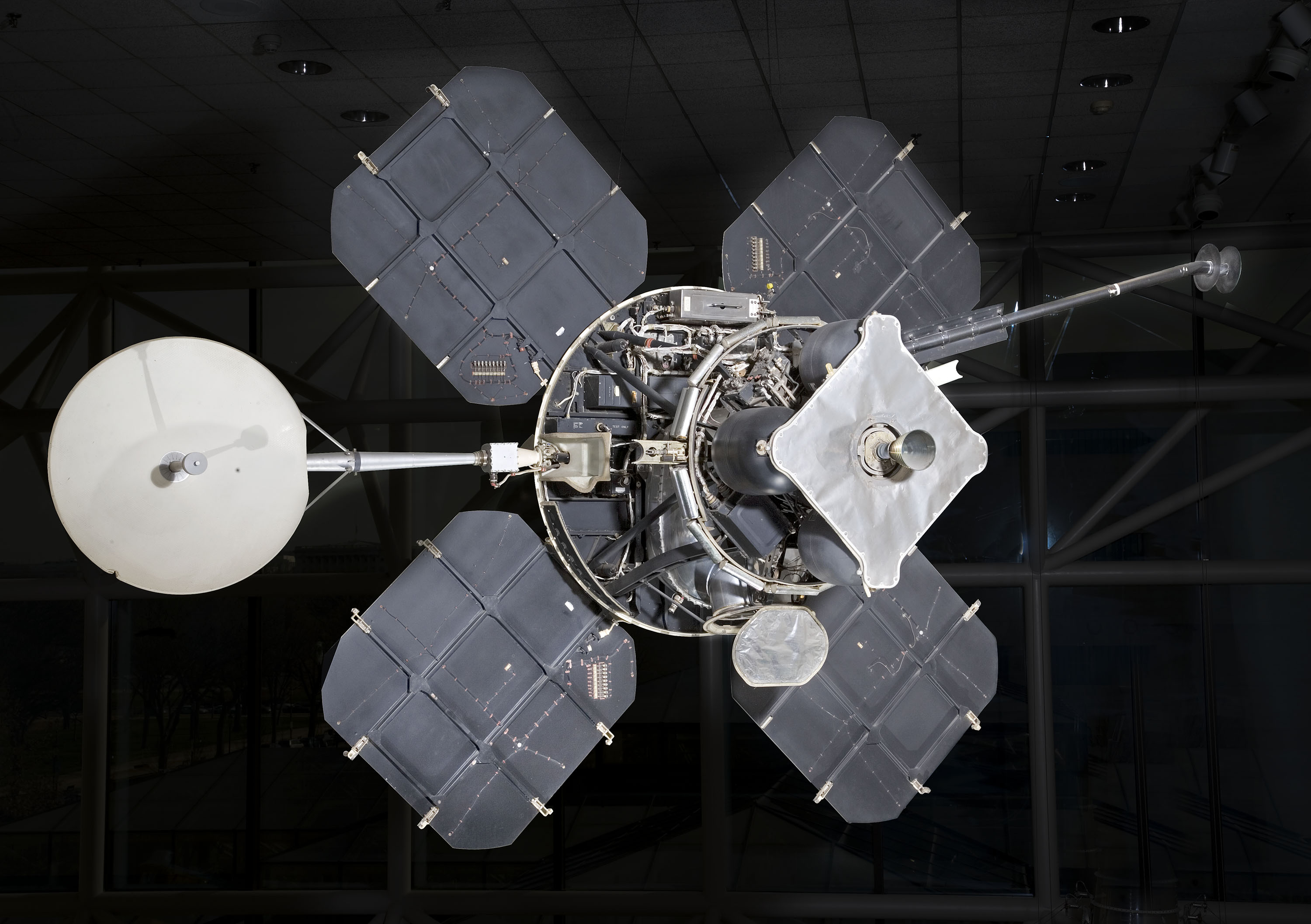
Detector, Plasma Wave, OGO-5
Object Details
- Manufacturer
- TRW Space & Technology Group
- Summary
- This is a flight spare for the sensor system carried on the Orbiting Geophysical Observatory V (OGO-V) satellite designed to measure the energy characteristics in the radiation belts surrounding the Earth. The long boom carries a set of special antennas which sent their signal to a small pre-amplifier attached to the base of the boom. From there the signal went into the main body amplifier (Catalogue #19860561000). This apparatus was manufactured by the Space and Technology Group of TRW; the firm donated it to the Museum in February 1985.
- OGO-V was the fifth in a series of standardized spacecraft capable of performing many related geophysical experiments during the middle 1960s. The sensor formed part of an experiment that measured the electrostatic and electromagnetic plasma properties of the region of space from the upper ionosphere to the solar wind. The flight model of the plasma wave detector was placed in orbit from Cape Kennedy on March 4, 1968. Data from this instrument provided the first evidence for the shock wave observed in the solar wind as it encounters the Earth's magnetic field, the so-called bow shock.
- Country of Origin
- United States of America
- See more items in
- National Air and Space Museum Collection
- Location
- National Air and Space Museum in Washington, DC
- Exhibition
- Kenneth C. Griffin Exploring the Planets Gallery
- Credit Line
- Gift of TRW Space and Technology Group
- Data Source
- National Air and Space Museum
- Inventory Number
- A19850560000
- Type
- INSTRUMENTS-Scientific
- Restrictions & Rights
- CC0
- Materials
- Non-Magnetic White Metal, Copper Alloys, Ferrous Alloy, Phenolic Resin, Epoxy, Paint, Mylar, Metallic Tape
- Dimensions
- 3-D: 53.3 × 43.2 × 134.6cm (1 ft. 9 in. × 1 ft. 5 in. × 4 ft. 5 in.)
- Record ID
- nasm_A19850560000
Slender metal boom topped by two orthogonally connected ring antennas; two sets of perpendicular rod antennas ending in rings are attached at almost even intervals below; wiring harness comes out close to bottom.