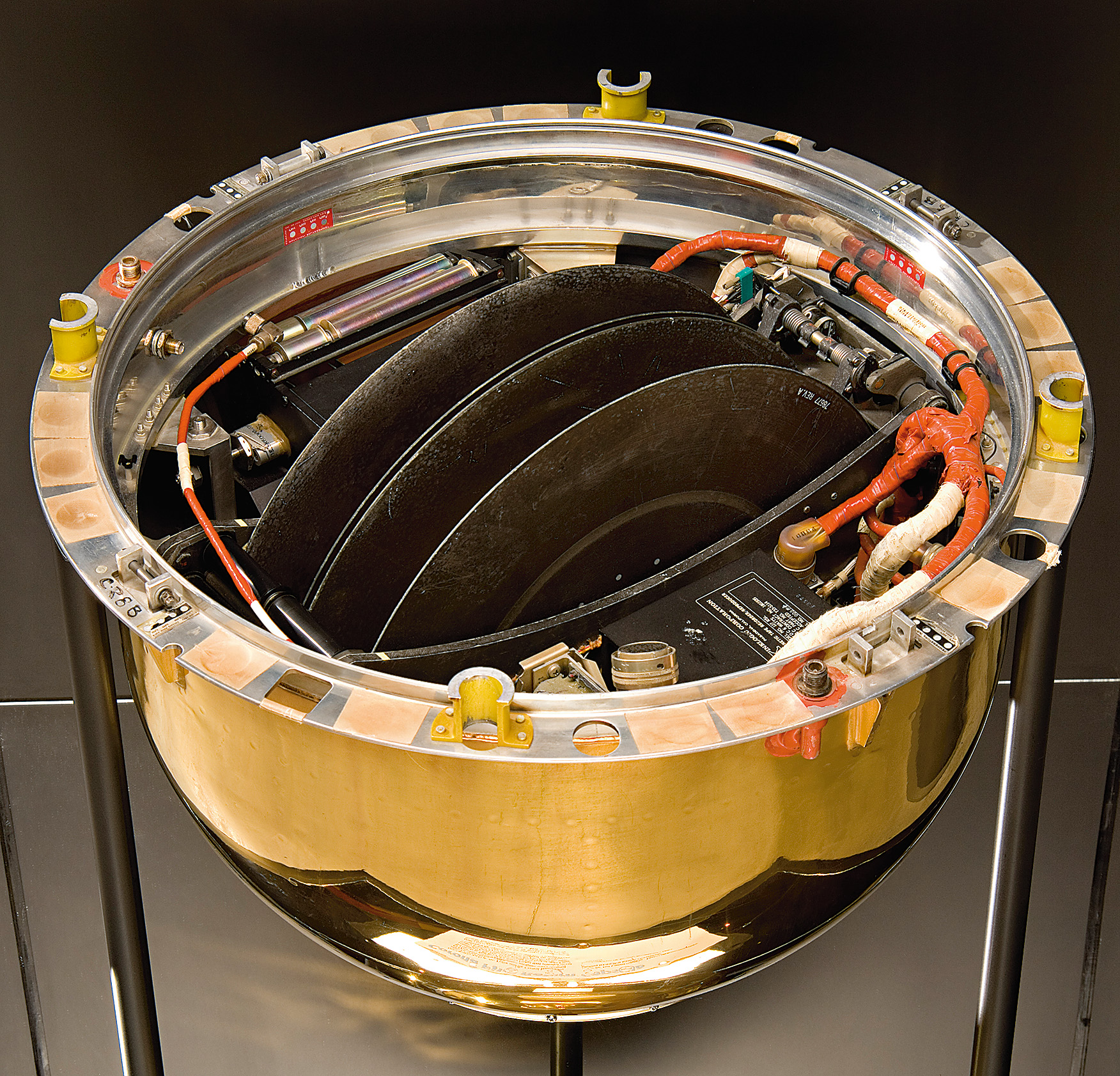
Camera, Corona, KH-4B
Object Details
- Manufacturer
- ITEK Corporation
- Summary
- The KH-4B was the last and most advanced camera system used in Project Corona, America and the world's first photoreconnaissance satellite program. Between August 1960 and May 1972, when the program ended, 145 Corona satellites were launched and they produced over 800,000 usable images of the USSR and other nations. Film return capsules containing the exposed film separated from the spacecraft in orbit, reentered the atmosphere, and were retrieved in midair. The Itek-made KH-4B camera was used from 1967 until the end of the program and under ideal conditions produced a ground resolution of 6 feet. This artifact was reconstructed from spare parts and was transferred to NASM by the National Reconnaissance Office in 1995.
- Alternate Name
- Corona KH-4B Camera
- Key Accomplishment(s)
- Last Camera Used in Project Corona
- Brief Description
- The KH-4B was the last and most advanced camera system used in Project Corona, America and the world's first photoreconnaissance satellite program.
- Country of Origin
- United States of America
- See more items in
- National Air and Space Museum Collection
- Credit Line
- Transferred from the National Reconnaissance Office
- Data Source
- National Air and Space Museum
- Inventory Number
- A19950117000
- Type
- SPACECRAFT-Uncrewed-Instruments & Payloads
- Restrictions & Rights
- Usage conditions apply
- Materials
- Metal, glass, polyester film
- Dimensions
- Overall: 5 ft. 8 in. × 5 ft. 2 in. × 5 ft. 5 in., 1135lb. (172.7 × 157.5 × 165.1cm, 514.8kg)
- Record ID
- nasm_A19950117000
2 optical lenses in black barrel-shaped housings; 2 film supply canisters at aft end; camera has cylindrical shape with film return bucket at front end; color; black and silver; metal stand painted cobalt blue.