
Explore a small selection of Open Access images from across the Smithsonian's collections. These images are all available to use for free, without asking.
Open Access Highlights
-
Lockheed Vega 5B, Amelia Earhart
-
The Girl I Left Behind Me
-
Cathedral Window Quilt
-
Peacock Side Chair
-
Treaty of Greenville medal
-
Alto saxophone owned and played by Charlie Parker
-
Olivetti Studio 46 Typewriter Used by Octavia Butler
-
Pinback Button, "Home Rule Charter, Yes!"
-
Black-and-white Ruffed Lemur
-
Banded iron
-
Command Module, Apollo 11
-
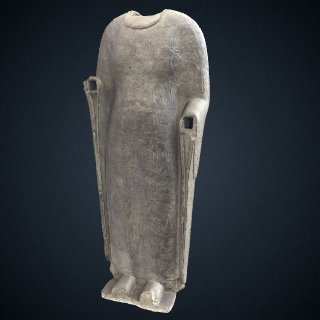 Buddha draped in robes portraying the Realms of Desire
d8c62be8-4ebc-11ea-b77f-2e728ce881253d_package:d8c62be8-4ebc-11ea-b77f-2e728ce881251https://3d-api.si.edu/content/document/3d_package:d8c62be8-4ebc-11ea-b77f-2e728ce88125/document.json
Buddha draped in robes portraying the Realms of Desire
d8c62be8-4ebc-11ea-b77f-2e728ce881253d_package:d8c62be8-4ebc-11ea-b77f-2e728ce881251https://3d-api.si.edu/content/document/3d_package:d8c62be8-4ebc-11ea-b77f-2e728ce88125/document.json- Date
- 550-577
- Period
- Northern Qi dynasty
- Label
- According to the sacred text of the Lotus Sutra, when the historical Buddha delivered a sermon a vision of the entire cosmos often appeared before him, which is why he was sometimes called the Cosmological Buddha. The decoration on the front and back of this figure's monastic robe features scenes of the life of the historical Buddha and cosmic imagery.
- On the front chest of the robe, Mount Sumeru, a sacred Buddhist mountain believed to connect heaven and earth, is depicted with two snakes, or naga, entwined around it. Scenes below illustrate the historical Buddha as a prince before his enlightenment. The tortures of hell appear above the hem.
- Provenance
- ?-1923
- Taku Shanfang, Beijing, method of acquisition unknown [1]
- From 1923
- Freer Gallery of Art, purchased by Carl Whiting Bishop (1881-1942) from Taku Shanfang, Beijing [2]
- Notes:
- [1] See Original Bishop List, Objects of Stone, No. S-9, copy in object file.
- [2] Carl Whiting Bishop purchased this on behalf of the Freer Gallery of Art on December 24, 1923, in Beijing from the art dealer, Taku Shanfang. See note 1. In 1922, the Smithsonian Institution and the Museum of Fine Arts, Boston jointly appointed Bishop, a trained archaeologist, as the leader of a four-year archaeological expedition to China. Around the same time, the Freer Gallery of Art appointed Bishop as a curator and charged him with purchasing works for the museum while abroad. This work was first accepted into the Freer Gallery of Art Study Collection in December 1923. In 1968, it was transferred to the Permanent Collection of the Freer Gallery of Art. See Bishop Collection, Collections Management Office.
- Research updated April 18, 2023
- Collection
- Freer Gallery of Art Collection
- Exhibition History
- Promise of Paradise (October 14, 2017 - ongoing)
- Body of Devotion: The Cosmic Buddha in 3D (January 30, 2016 to July 9, 2017)
- Promise of Paradise: Early Chinese Buddhist Sculpture (December 1, 2012 to January 3, 2016)
- Buddhist Art (May 9, 1993 to August 9, 2011)
- Chinese Art—Stone Sculpture (September 1, 1979 to March 14, 1982)
- Chinese Art (January 1, 1963 to March 6, 1981)
- Previous custodian or owner
- Taku Shanfang
- Origin
- Anyang, Henan province, China
- Topic
- stone
- Buddhism
- Buddha
- Sui dynasty (581 - 618)
- naga
- hell
- heaven
- China
- Vairocana Buddha
- Mount Meru
- Lotus Sutra
- Chinese Art
- Carl Whiting Bishop collection
- On View
- West Building (Freer Gallery of Art), Gallery 17: Promise of Paradise
- Related Online Resources
- Google Arts & Culture
- See more items in
- National Museum of Asian Art
- Credit Line
- Purchase — Charles Lang Freer Endowment
- Data Source
- National Museum of Asian Art
- Accession Number
- F1923.15
- Type
- Sculpture
- Restrictions & Rights
- CC0
- Medium
- Limestone
- Dimensions
- H x W x D: 151.3 x 62.9 x 31.3 cm (59 9/16 x 24 3/4 x 12 5/16 in)
- Weight (without concrete base): 818.5 pounds
edanmdm:fsg_F1923.15- Record ID
- 3dp-1581689061667-1581710144840-0
-
Jar
-
Placard stating "HONOR KING: END RACISM" carried in 1968 Memphis March
-
African Lion
-
24c Curtiss Jenny invert single
-
The Negro Motorist Green-Book
-
Wilson Bentley Photomicrograph of Stellar Snowflake No. 990
-
 Bell X-1
6c69a6bb-55e6-4356-8725-120ff7f8d6523d_package:6c69a6bb-55e6-4356-8725-120ff7f8d6521https://3d-api.si.edu/content/document/3d_package:6c69a6bb-55e6-4356-8725-120ff7f8d652/document.json
Bell X-1
6c69a6bb-55e6-4356-8725-120ff7f8d6523d_package:6c69a6bb-55e6-4356-8725-120ff7f8d6521https://3d-api.si.edu/content/document/3d_package:6c69a6bb-55e6-4356-8725-120ff7f8d652/document.json- Date
- 1946
- Manufacturer
- Bell Aircraft Corp.
- Physical Description
- Single engine, single seat, mid-wing rocket plane with international orange paint scheme.
- Summary
- On October 14, 1947, the Bell X-1 became the first airplane to fly faster than the speed of sound. Piloted by U.S. Air Force Capt. Charles E. "Chuck" Yeager, the X-1 reached a speed of 1,127 kilometers (700 miles) per hour, Mach 1.06, at an altitude of 13,000 meters (43,000 feet). Yeager named the airplane "Glamorous Glennis" in tribute to his wife.
- Air-launched at an altitude of 7,000 meters (23,000 feet) from the bomb bay of a Boeing B-29, the X-1 used its rocket engine to climb to its test altitude. It flew a total of 78 times, and on March 26, 1948, with Yeager at the controls, it attained a speed of 1,540 kilometers (957 miles) per hour, Mach 1.45, at an altitude of 21,900 meters (71,900 feet). This was the highest velocity and altitude reached by a manned airplane up to that time.
- Long Description
- On October 14, 1947, flying the Bell XS-1 #1, Capt. Charles 'Chuck’ Yeager, USAF, became the first pilot to fly faster than sound. The XS-1, later designated X-l, reached Mach 1.06, 700 mph, at an altitude of 43,000 feet, over the Mojave Desert near Muroc Dry Lake, California. The flight demonstrated that aircraft could be designed to fly faster than sound, and the concept of a ‘sound barrier" crumbled into myth.
- The XS-1 was developed as part of a cooperative program initiated in 1944 by the National Advisory Committee for Aeronautics (NACA) and the U.S. Army Air Forces (later the U.S. Air Force) to develop special manned transonic and supersonic research aircraft. On March 16, 1945, the Army Air Technical Service Command awarded the Bell Aircraft Corporation of Buffalo, New York, a contract to develop three transonic and supersonic research aircraft under project designation MX-653. The Army assigned the designation XS-1 for Experimental Sonic-i. Bell Aircraft built three rocket-powered XS-1 aircraft.
- The National Air and Space Museum now owns the XS-1 #1, serial 46-062, named Glamorous Glennis by Captain Yeager in honor of his wife. The XS-1 #2 (46-063) was flight-tested by NACA and later was modified as the X-1 "Mach 24" research airplane. (The X-1 E is currently on exhibit outside the NASA Flight Research Center, Edwards, California.) The X-1 #3 (46-064) had a turbopump-driven, low-pressure fuel feed system. This aircraft, known popularly as the X-1-3 Queenie, was lost in a 1951 explosion on the ground that injured its pilot. Three additional X-1 aircraft, the X-1A, X-1B, and X-1D, were constructed and test-flown. Two of these. the X-1A and X-1D, were also lost, as a result of propulsion system explosions.
- The two XS-1 aircraft were constructed from high-strength aluminum, with propellant tanks fabricated from steel. The first two XS-1 aircraft did not utilize turbopumps for fuel feed to the rocket engine, relying instead on direct nitrogen pressurization of the fuel-feed system. The smooth contours of the XS-1, patterned on the lines of a .50-caliber machine gun bullet, masked an extremely crowded fuselage containing two propellant tanks, twelve nitrogen spheres for fuel and cabin pressurization, the pilot’s pressurized cockpit, three pressure regulators, a retractable landing gear, the wing carry-through structure, a Reaction Motors, Inc., 6.000-pound-thrust rocket engine, and more than five hundred pounds of special flight-test instrumentation.
- Though originally designed for conventional ground takeoffs, all X-1 aircraft were air-launched from Boeing B-29 or B-50 Superfortress aircraft. The performance penalties and safety hazards associated with operating rocket-propelled aircraft from the ground caused mission planners to resort to air-launching instead. Nevertheless, on January 5,1949, the X-1 #1 Glamorous Glennis successfully completed a ground takeoff from Muroc Dry Lake, piloted by Chuck Yeager. The maximum speed attained by the X-1 #1 was Mach 1.45 at 40,130 feet, approximately 957 mph, during a flight by Yeager on March 26, 1948. On August 8,1949, Maj. Frank K. Everest, Jr., USAF, reached an altitude of 71,902 feet, the highest flight made by the little rocket airplane. It continued flight test operations until mid-1950, by which time it had completed a total of nineteen contractor demonstration flights and fifty-nine Air Force test flights.
- On August 26, 1950, Air Force Chief of Staff Gen. Hoyt Vandenberg presented the X-1 #1 to Alexander Wetmore, then Secretary of the Smithsonian Institution. The X-1, General Vandenberg stated, "marked the end of the first great period of the air age, and the beginning of the second. In a few moments the subsonic period became history and the supersonic period was born." Earlier, Bell Aircraft President Lawrence D. Bell, NACA scientist John Stack, and Air Force test pilot Chuck Yeager had received the 1947 Robert J. Collier Trophy for their roles in first exceeding the speed of sound and opening the pathway to practical supersonic flight.
- Alternate Name
- Bell X-1 Glamorous Glennis
- Key Accomplishment(s)
- Broke the Sound Barrier
- Impact or Innovation
- The X-1 proved an aircraft could travel faster than sound and gathered transonic flight data that is still valuable.
- Brief Description
- On October 14, 1947, the Bell X-1 became the first airplane to fly faster than the speed of sound. It was piloted by U.S. Air Force Capt. Charles E. "Chuck" Yeager who named the aircraft Glamorous Glennis in tribute to his wife.
- Country of Origin
- United States of America
- See more items in
- National Air and Space Museum Collection
- Location
- National Air and Space Museum in Washington, DC
- Exhibition
- Boeing Milestones of Flight Hall
- Credit Line
- Transferred from the Department of the Air Force
- Data Source
- National Air and Space Museum
- Inventory Number
- A19510007000
- Type
- CRAFT-Aircraft
- Restrictions & Rights
- CC0
- Materials
- Aluminum, steel, glass, paint, foam, fabric, rubber, asbestos, magnesium, radium paint, plexi glass, leather
- Dimensions
- Other: 10 ft. 8 1/2 in. × 30 ft. 9 in. × 28 ft., 2780.5kg (326.4 × 937.3 × 853.4cm, 6130lb.)
edanmdm:nasm_A19510007000- Record ID
- 123-1581107138697-1581450540987-0
-
Buddha Amitabha (Amita) and the Eight Great Bodhisattvas
-
 Tin for Madame C.J. Walker's Wonderful Hair Grower
5e37d1c8-6dce-46d5-9324-871eddba43133d_package:5e37d1c8-6dce-46d5-9324-871eddba43131https://3d-api.si.edu/content/document/3d_package:5e37d1c8-6dce-46d5-9324-871eddba4313/document.json
Tin for Madame C.J. Walker's Wonderful Hair Grower
5e37d1c8-6dce-46d5-9324-871eddba43133d_package:5e37d1c8-6dce-46d5-9324-871eddba43131https://3d-api.si.edu/content/document/3d_package:5e37d1c8-6dce-46d5-9324-871eddba4313/document.json- Date
- 1910s - 1920s
- Manufactured by
- Madam C.J. Walker Manufacturing Company, American, founded 1906
- Subject of
- Madam C.J. Walker, American, 1867 - 1919
- Description
- The canister is metal with yellow lacquer coloring its external surface. The outside of the canister is covered with textual and illustrative designs in black ink printed on top of the yellow lacquer. The product name [WONDERFUL HAIR GROWER] is written in horizontal text across the center of the lid beneath an ink illustration of a black woman pictured from her shoulders up with her hair down. Beneath the product name are additional lines of text which read [NET CONTENTS 2 OZ/MADE BY/THE MADAM C.J. WALKER/MANUFACTURING CO./INDIANAPOLIS, IND./PRICE 50 CENTS]. Above the illustration and curved to the arc of the lid edge is the brand name of the product in black text [MADAM C. J. WALKERS/TRADE MARK REGISTERED].
- Transcription Center Status
- Transcribed by digital volunteers
- Place made
- Indianapolis, Marion County, Indiana, United States, North and Central America
- Topic
- African American
- Business
- Hair
- Women
- See more items in
- National Museum of African American History and Culture Collection
- Classification
- Accessories and Personal Effects
- Exhibition
- Defending Freedom, Defining Freedom: The Era of Segregation, 1876-1968
- On View
- NMAAHC (1400 Constitution Ave NW), National Mall Location, Concourse 2, C 2053
- Credit Line
- Collection of the Smithsonian National Museum of African American History and Culture, Gift from Dawn Simon Spears and Alvin Spears, Sr.
- Data Source
- National Museum of African American History and Culture
- Object number
- 2011.159.6
- Type
- canisters
- Restrictions & Rights
- No Known Copyright Restrictions
- Proper usage is the responsibility of the user.
- Medium
- metal
- Dimensions
- Diameter: 2 3/4 × 13/16 in. (7 × 2.1 cm)
edanmdm:nmaahc_2011.159.6- Record ID
- 123-1581107138697-1581459797925-0
-
Smithsonite
-
In the Sunlight
-
The Death of Cleopatra